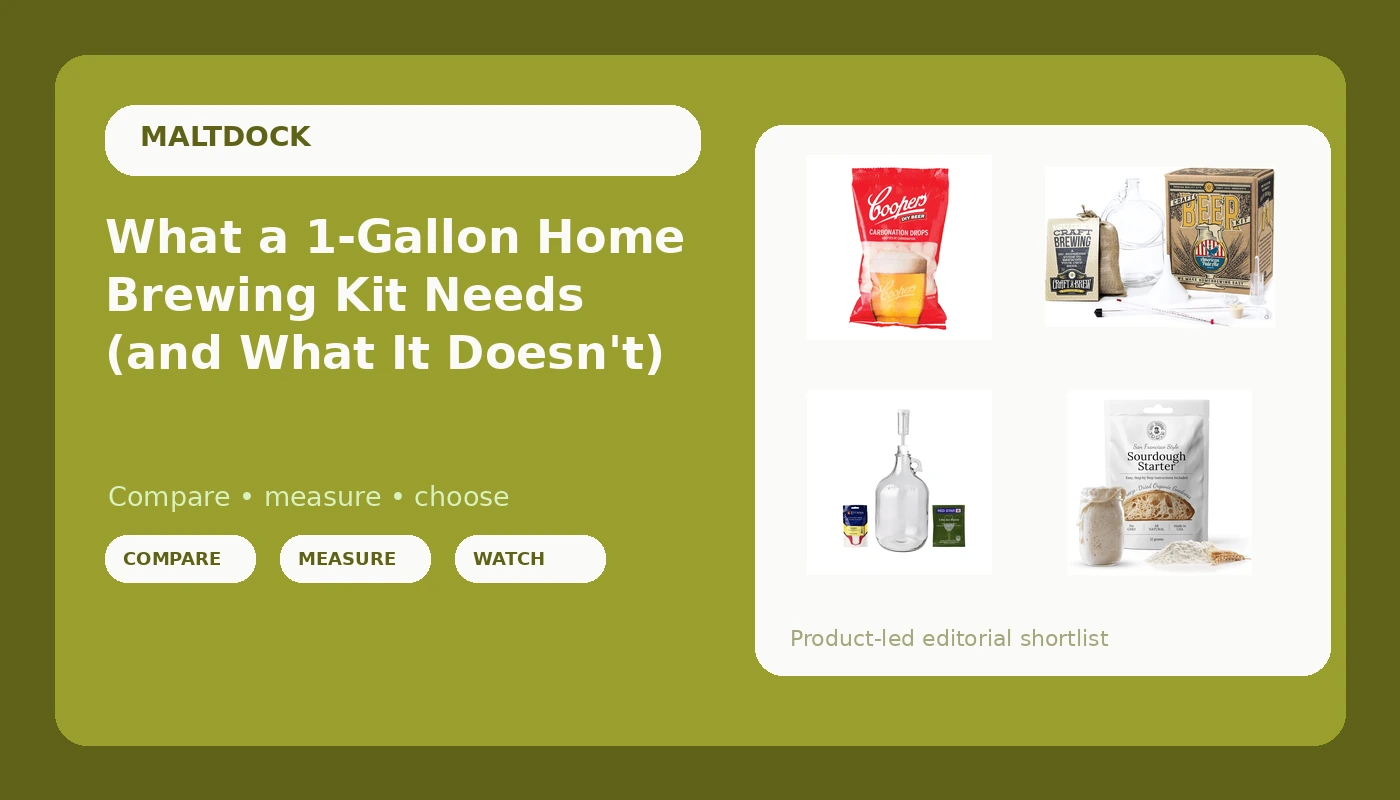
I get some version of the same question every month, usually from someone standing in a kitchen holding a box: what does a 1-gallon home brewing kit actually need to include before the beer has a real chance? The honest answer is that the brand on the box matters far less than the checklist inside it. A gallon is roughly ten twelve-ounce bottles, which means a mistake costs you ten bottles instead of fifty, and that is precisely why small batches are the right place to learn. Small batches also hide problems, though. A fermenter with too little headroom foams over the rim. A kit that skips the hydrometer leaves you guessing at original gravity and final gravity, which means you never learn what your yeast actually did. Here is what belongs on the shelf, and how four products map onto that list.
Related: How to Read a Hydrometer Without Fooling Yourself →
Quick answer
A 1-gallon home brewing kit needs five things: a fermenter sized for the batch with headroom for krausen, an airlock and stopper, a no-rinse sanitizer, a hydrometer, and a packaging plan. Everything else is convenience. The Craft A Brew American Pale Ale kit is the beer-focused option here and is sold as a complete equipment and supplies package for a 1-gallon batch. The FastRack Shepherd Made Mead Making Kit covers the glass jug, airlocks, stopper, yeast nutrient, and mead yeast side of the same hobby. Coopers Carbonation Drops handle priming at the bottle instead of in a bucket, and the My Rustic Roots sourdough starter is a separate wild fermentation entirely, for the bread side of the kitchen. Do not assume any kit is complete until you have read its contents list against that five-item checklist.
Four useful options
| Model | Best fit | What stands out |
|---|---|---|
| Craft A Brew American Pale Ale Beer Making Kit | A first 1-gallon beer batch | Sold as a complete equipment and supplies package for a 1-gallon American pale ale |
| FastRack Shepherd Made Mead Making Kit | Mead instead of beer | 1-gallon clear glass fermentation jar with 3 airlocks, a rubber stopper, yeast nutrient, and mead yeast |
| Coopers DIY Home Brewing Carbonation Drops | Bottle-by-bottle priming | Pre-measured carbonation drops that replace bulk priming sugar |
| My Rustic Roots Organic San Francisco Sourdough Starter Culture | Bread and wild-culture practice | A 12g organic San Francisco sourdough culture rather than a single-use packet |
First beer batch: Craft A Brew American Pale Ale Beer Making Kit
The reason I point beginners at a one-gallon beer kit first is not the beer, it is the repetition. Ten bottles means you can brew again in three weeks instead of two months, and repetition is the only thing that turns a recipe into a habit. The style choice matters too. An American pale ale is forgiving of a garage that swings a few degrees, and it gives you a beer where off flavors from a warm fermentation actually show up in the glass, which is a lesson worth learning early. What a kit like this cannot do is teach you to measure. Gravity readings, temperature logs, and sanitation notes are on you, and no contents list will cover for skipping them.
Mead side of the hobby: FastRack Shepherd Made Mead Making Kit
Mead is honey, water, yeast, and nutrient, and that last item is the one most people forget. Honey is a poor source of the nitrogen and micronutrients yeast needs, which is why a mead that stalls at two-thirds of the way through fermentation is such a common first-mead story. A kit that ships nutrient alongside the yeast is doing you a real favor. Glass is the other detail worth noticing: a clear jug lets you watch the fermentation without opening the vessel, and every time you open a fermenter you trade a little protection for a little information. Three airlocks in one set also means a spare, and a spare airlock is the cheapest insurance in this hobby. The tradeoff is time. Mead runs on a longer clock than beer, so plan on patience rather than a quick pipeline.
Bottling without guesswork: Coopers DIY Home Brewing Carbonation Drops
Priming is where small-batch brewers lose the most consistency, and the cause is usually arithmetic. Batch priming asks you to dissolve a weighed amount of sugar in a measured volume of water, mix it evenly through the whole batch without splashing oxygen into the beer, and then fill every bottle with the same concentration. Get the mixing uneven and you end up with gushers in some bottles and flat beer in others. Drops move that decision to the bottle, one dose at a time, which is a genuine simplification when your entire batch is ten bottles and you have no bottling bucket to stir in. Read the package directions for your bottle size rather than assuming a count, because the right dose depends on how much beer is going into each bottle.
Wild fermentation crossover: My Rustic Roots Organic San Francisco Sourdough Starter Culture
I want to be blunt about this one, because it sits on a home brewing shelf and it does not belong in a fermenter of wort. A sourdough starter is a wild culture of yeast and bacteria balanced for bread dough, not a brewing yeast pitched into beer, and it is not a substitute for the yeast a beer or mead kit provides. What it does offer is practice. Keeping a culture alive means feeding it on a schedule, watching how temperature changes its activity, and learning to smell when it is healthy versus when it has gone off. Those instincts transfer directly to yeast handling and to spotting a fermentation that is not behaving. If you brew and bake in the same kitchen, this is the same skill practiced on a different substrate.
Prices and availability may change. Product images, names, and retailer links are matched to verified listings. No current price, rating, stock status, or measured result is stated here without current evidence.
What a 1-gallon batch actually requires
Headroom is the first thing a small fermenter gets wrong. Krausen, the foamy head that forms during active fermentation, can climb several inches in a vigorous batch, and a 1-gallon jug filled to the shoulder with wort has nowhere for it to go. Leaving roughly a fifth of the vessel empty is the difference between a clean airlock and a mess on the shelf. The airlock and stopper are next: they let carbon dioxide out and keep air and dust from drifting in, and they are the cheapest parts to keep a spare of.
Sanitation is the part nobody enjoys and everybody who has dumped a batch wishes they had taken seriously. Anything that touches wort after the boil has ended must be clean and sanitized, including the siphon, the bottling wand, the caps, and your hands. Fermentation temperature is the other silent variable. Ambient air in a garage can run several degrees cooler or warmer than the liquid in the jug, and yeast responds to the liquid, not the room.
Measurement is where the kit conversation usually ends and the notebook begins. A hydrometer, calibrated in distilled water at 60°F, gives you original gravity before fermentation and final gravity after it. The gap between those two numbers is your attenuation, and attenuation is how you know the yeast finished the job rather than stalled. Take the sample, cool it to the calibration temperature, read it at eye level, and write it down. A refractometer is faster on brew day, but it reads alcohol-containing samples inaccurately without a correction, so keep both and trust the float for final gravity.
The five-step read on any kit
- Read the contents list against the five-item checklist before you buy: fermenter with headroom, airlock and stopper, sanitizer, hydrometer, packaging plan.
- Confirm the batch size on the label matches the fermenter you actually own, because a 1-gallon recipe in a 1-gallon jug with no headroom will foam over.
- Sanitize every surface that touches wort after the boil, then leave the fermenter closed until fermentation visibly slows.
- Record original gravity on brew day and fermentation temperature daily, since both numbers explain most of what a finished beer tastes like.
- Confirm final gravity with two readings taken about 48 hours apart before you package, then decide whether you are priming with drops or with dissolved sugar.
Sizing, priming, and shelf reality
- A 1-gallon batch yields roughly ten twelve-ounce bottles, so plan your bottle count before packaging day, not during it.
- Match your priming method to your equipment: drops for bottle-by-bottle dosing, dissolved sugar when you have a vessel big enough to mix the whole batch evenly.
- Keep a spare airlock, stopper, and a length of siphon tubing on hand, because these are the parts that fail at the worst possible moment.
- Store a live culture like a sourdough starter on a feeding schedule and keep it away from your brewing yeast, since cross-contamination runs both directions.
- Add equipment only after three logged batches. Three brew days tell you more about what you actually need than any contents list.
Which option should you choose?
Choose the Craft A Brew American Pale Ale Beer Making Kit when you want to make beer and you want the equipment and supplies in one package sized to a 1-gallon batch. Choose the FastRack Shepherd Made Mead Making Kit when mead is what you want to ferment, or when you need a glass jug, airlocks, a stopper, nutrient, and mead yeast as a set. Choose the Coopers DIY Home Brewing Carbonation Drops when you are bottling small batches directly from the fermenter and would rather dose each bottle than mix priming sugar through the whole batch. Choose the My Rustic Roots Organic San Francisco Sourdough Starter Culture when your interest is wild fermentation on the bread side of the kitchen, not beer.
One caveat worth stating plainly: none of the descriptions above include a current price, a rating, or a performance claim, because those change and I am not going to quote a number I cannot stand behind. What a listing tells you is what is in the box. Whether a kit works for you depends on your fermentation temperature, your sanitation habits, and whether you actually take gravity readings. Those are the variables that decide the beer.
The bottom line
The kit is not the batch. A 1-gallon home brewing kit earns its place on your shelf when it gives you a fermenter with real headroom, an airlock and stopper, a sanitizer, and a reason to own a hydrometer, and when it leaves you a clear path to packaging. Craft A Brew covers the beer side as a complete equipment and supplies package. FastRack covers the mead side with a glass jug and the small parts that stall a first mead when they are missing. Coopers carbonation drops simplify the last step for anyone bottling ten bottles at a time. The sourdough starter is a different ferment for a different counter, and it is honest about being one. Buy the checklist, log your numbers, and let the third batch tell you what to upgrade.