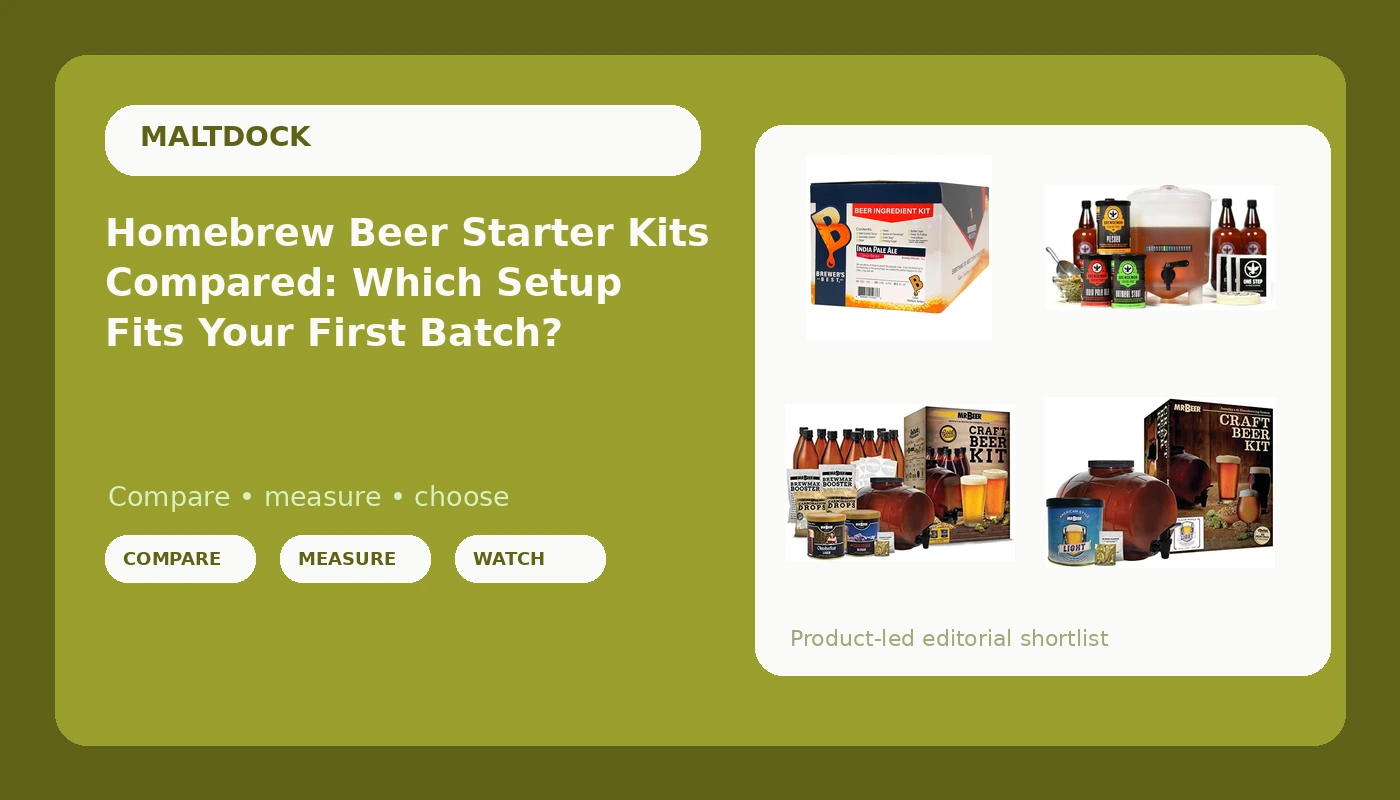
Most first-time brewers stall on the same question: what does a homebrew beer starter kit actually contain, and which version gets you to a carbonated, drinkable beer without a second trip to the store? The four products below answer that question four different ways. One is a compact 1-gallon conical setup that ships with bottles and three recipes. Two are Mr. Beer sets, one at 2 gallons and one at 4, that arrive with a fermenter, bottles, and a refill. One is an ingredient kit only, which means it assumes the fermenting and bottling hardware is already on your shelf. None of these is a bad purchase. They start at different points on the same road, and starting at the wrong point is how a first batch turns into a box in the garage.
Related: Extract vs All-Grain: What Actually Changes on Brew Day →
Quick answer
If you own no brewing equipment at all, buy a complete set: a 1-gallon kit for small kitchens and small yields, a 2-gallon Mr. Beer set for a middle ground, or the 4-gallon Mr. Beer set if you want closer to two cases per batch. If you already own a fermenter, bottling gear, and a capper, an ingredient-only kit costs less per batch because you are paying for recipe components rather than duplicate hardware.
Four useful options
| Model | Best fit | What stands out |
|---|---|---|
| Little Demon Craft Beer Bonus Kit, 1 Gal Conical with Bottles & 3 Recipes | Small-space brewers and first-timers | 1-gallon conical fermenter, bottles, and three recipes in one box |
| Mr. Beer - Craft Beer Making Kit (2 Gallon) Starter DIY Home Brew Set | Make Your Own Craft Beer | American Light | Brewers who want a complete set in a compact size | Complete 2-gallon set with an American Light refill |
| Mr. Beer - Craft Beer Making Kit 4 Gallon Complete DIY Home Brew Set Everything Included, Bottles, Refills Brew in 30 Minutes | Beginners starting from zero who want a bigger yield | Complete 4-gallon set with bottles and refills included |
| India Pale Ale Homebrew Beer Ingredient Kit Brewers Best | Brewers who already own fermenting and bottling equipment | Ingredients only, so no duplicate gear |
Smallest footprint: Little Demon Craft Beer Bonus Kit, 1 Gal Conical with Bottles & 3 Recipes
The trade-off is volume and the calendar. A gallon of wort is a small thermal mass, so it tracks the room temperature faster than a full 5-gallon batch would, and the conical shape concentrates trub and yeast into a narrower collection zone at the bottom rather than spreading it across a flat floor. Both are real advantages, and both come with a ceiling: ten bottles disappear quickly, and anyone who catches the bug will be shopping again within a few months. That is fine. The point of a small kit is to prove the process works before you spend real money on it.
Compact complete set: Mr. Beer - Craft Beer Making Kit (2 Gallon) Starter DIY Home Brew Set | Make Your Own Craft Beer | American Light
The honest read on a kit like this is that it teaches the rhythm of brewing, not the craft of recipe design. You will learn what a fermenter looks like during high krausen, what a bottling day actually costs you in time, and how much of a batch you lose to trub and sampling. What you will not learn from an included light-style refill is how to hit a target gravity on purpose. Pair it with a hydrometer and a notebook and it becomes a genuinely useful teaching tool instead of a novelty.
Largest complete set: Mr. Beer - Craft Beer Making Kit 4 Gallon Complete DIY Home Brew Set Everything Included, Bottles, Refills Brew in 30 Minutes
Yield is the whole argument for this one. Two cases per batch means fewer brew days per year for the same amount of beer, which matters if your weekends are already spoken for. It also means every mistake is amplified: a 4-gallon batch that ferments too warm, gets oxygenated at packaging, or sits on the yeast too long costs you two cases instead of ten bottles. Bigger batches reward temperature control and clean sanitation, so budget for those habits before you budget for volume.
Ingredients only: India Pale Ale Homebrew Beer Ingredient Kit Brewers Best
This is the cheapest path in the hobby and the most expensive one, depending on what is already in your closet. Buy it as your first purchase and you still need a fermenter, a siphon, sanitizer, bottles, caps, and a capper, which is a lot of separate orders. Buy it after a starter kit and it is simply a recipe in a box, and an IPA is a good choice because the style is unforgiving in a useful way: hop aroma fades with oxygen exposure and age, so it teaches you to package cleanly and drink fresh.
Prices and availability may change. Product images, names, and retailer links are matched to verified listings. No current price, rating, stock status, or measured result is stated here without current evidence.
What a complete set has to cover
Strip away the branding and a complete kit is a short list of jobs: hold the wort while yeast works, keep oxygen and wild microbes out, move liquid without splashing, measure what happened, and get carbonated beer into a sealed bottle. The equipment that does those jobs is a fermenter with a lid and airlock, a sanitizer, food-grade tubing, a bottling bucket or a spigot, bottles, caps, and a capper.
The item that separates a serious kit from a toy is the hydrometer. Gravity is the only honest number in brewing. A hydrometer reading before fermentation gives you the original gravity, or OG, and a reading after fermentation finishes gives you the final gravity, or FG. The gap between them tells you how much sugar the yeast actually ate, which is the real attenuation, and it is the only way to know whether the beer is done or merely stalled. A kit that ships without one is not saving you money; it is removing your ability to answer the one question that matters most on bottling day.
Also check for a thermometer. Fermentation temperature is the single largest lever a new brewer has, and it is invisible without a reading. Ales fermented in the low-to-mid 60s Fahrenheit taste clean; the same wort at 78°F produces the banana and bubblegum esters that make people think they dislike homebrew.
Batch size and the numbers worth writing down
Batch size decides everything downstream: how much beer you get, how much a mistake costs, and how much space the fermenter takes. One gallon is about ten 12-ounce bottles, 2 gallons is about twenty-one, and 4 gallons is about forty-two. The math is simple, but the consequences are not. Small batches are cheap to repeat and easy to store cold. Large batches are efficient and demand more discipline.
The numbers to log on every batch are OG, FG, fermentation temperature, and the date of each reading. From OG and FG you can calculate alcohol by volume with a standard approximation: subtract FG from OG and multiply by 131.25. A beer that starts at 1.052 and finishes at 1.012 lands near 5.2 percent ABV and attenuates at roughly 77 percent. Write those figures down. A notebook turns a hobby into a process, and a process is what makes batch ten better than batch one.
- Count what you already own before you buy anything, including a capper, bottles, and sanitizer.
- Pick batch size from how much you drink and how much cold space you have, not from what looks impressive.
- Decide whether you want a specific style in the box or a neutral starter beer that a beginner can execute cleanly.
- Confirm the kit includes a hydrometer and a thermometer, or add both to the order on day one.
- Plan fermentation temperature control before brew day, because it cannot be fixed after the yeast is pitched.
Practical guidance before you order
- Sanitation is not optional and not a step you can shortcut. Everything that touches wort after the boil ends must be clean and sanitized.
- Calibrate the hydrometer in distilled water at 60°F before you trust a single reading, and recheck it whenever a number looks wrong.
- Take two FG readings 24 to 48 hours apart. Bottling at a gravity that is still dropping produces gushers or, worse, bottle bombs.
- Keep the fermenter out of direct sun and away from furnace rooms. Stable temperature matters more than any single piece of gear.
- Save the instructions and the recipe sheet from the first kit. Two years from now, that page is the only record of what you actually brewed.
Which option should you choose?
Choose the Little Demon Craft Beer Bonus Kit, 1 Gal Conical with Bottles & 3 Recipes when you have limited counter space, want to learn the full process on a small scale, and like the idea of three different recipes in one box. Choose the Mr. Beer - Craft Beer Making Kit (2 Gallon) Starter DIY Home Brew Set | Make Your Own Craft Beer | American Light when you want a complete, self-contained set at a compact size and an easy-drinking light style for the first batch. Choose the Mr. Beer - Craft Beer Making Kit 4 Gallon Complete DIY Home Brew Set Everything Included, Bottles, Refills Brew in 30 Minutes when yield is the priority and you want roughly two cases from a single brew day. Choose the India Pale Ale Homebrew Beer Ingredient Kit Brewers Best when you already own the fermenting and bottling hardware and want to brew a specific style instead of buying gear you do not need.
One caveat applies to all four: what ships inside a box can change between production runs, and listings are updated over time. Read the current contents list before you order rather than assuming the description above is frozen in place.
The bottom line
The right homebrew beer starter kit is the one that matches the gear you already own and the batch size you will actually drink. If you are starting from nothing, a complete set removes the most common failure mode in the hobby, which is a stalled first brew day caused by one missing part. If you already have a fermenter and a capper, an ingredient kit is the smarter spend because every dollar goes into beer instead of duplicate plastic. Whichever route you take, add a hydrometer and a thermometer if they are not already in the box, log your OG and FG, and hold fermentation temperature steady. Those three habits do more for the beer in your glass than any upgrade you can buy.