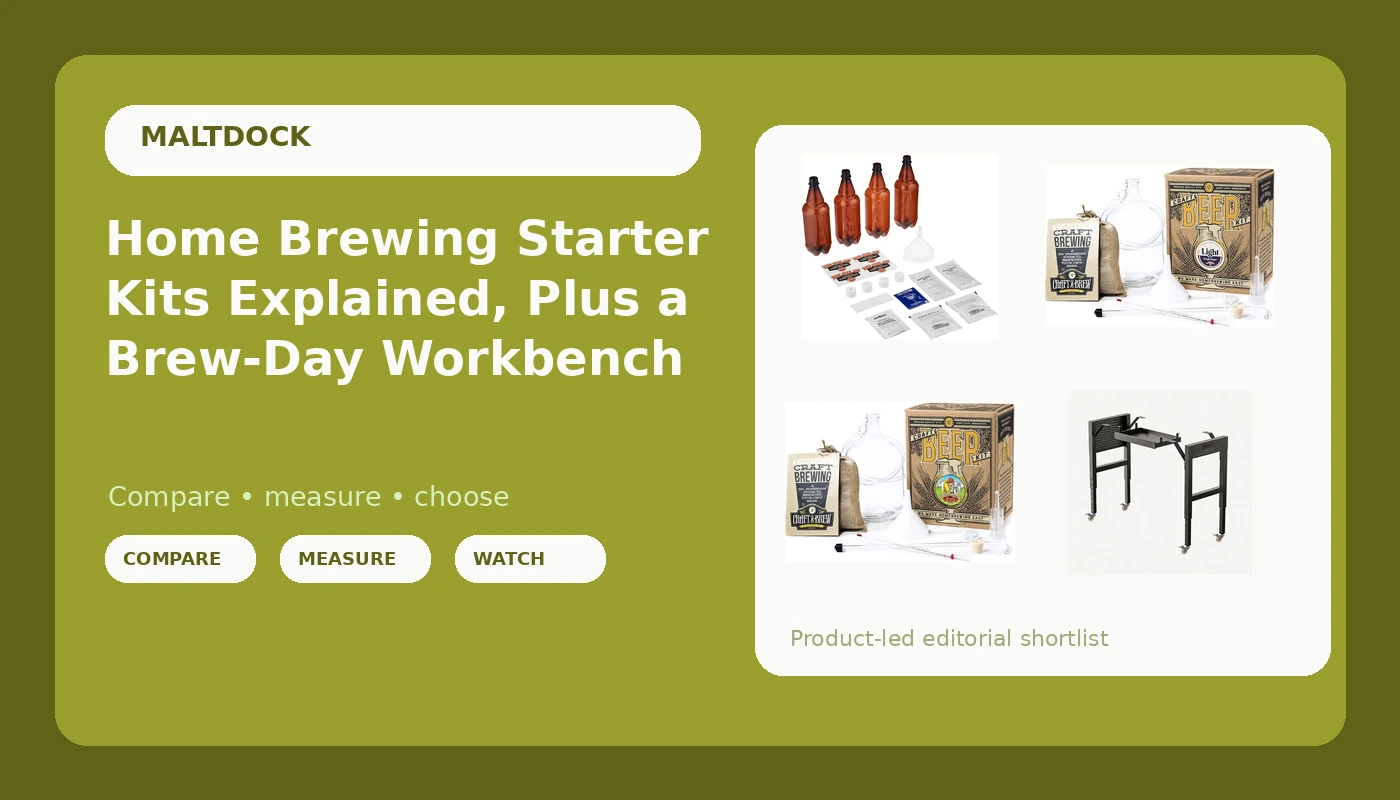
Home brewing starter kits are sold on one promise and deliver on several different ones. A root beer kit, a one-gallon lager kit, a one-gallon Oktoberfest ale kit, and a height-adjustable workbench can all surface in the same search results, and they solve four different problems. If you are assembling a first setup, the question that matters is not which box is biggest. It is which box matches the drink you actually want, the fermentation temperature you can hold, and the surface you have to work on.
Related: How to Sanitize Brewing Equipment Without Losing a Batch →
Quick answer
For most first-time brewers, a one-gallon beer kit is the right starting point. The batch is small enough to sit on a kitchen counter, the equipment list is short, and a mistake costs you one gallon instead of five. A root beer kit is the better pick if you want a short project and a finished drink that does not require you to hold a fermentation temperature for two weeks. The height-adjustable workbench legs are not a brewing kit at all; they are the bench that keeps a fermenter, a bottling bucket, and a capper at a height your back can tolerate.
Four useful options
| Model | Best fit | What stands out |
|---|---|---|
| Mr. Root Beer Home Brewing Root Beer Kit | A first project on a short timeline | Root beer rather than beer, so the process is closer to mixing and bottling than to a full brew day |
| Craft A Brew - Light - Craft Lager - Beer Making Kit - Make Your Own Craft Beer - Complete Equipment and Supplies - Starter Home Brewing Kit - 1 Gallon | A brewer who wants a crisp, clean beer | Complete one-gallon equipment and supplies built around a light lager style |
| Craft A Brew - Oktoberfest Ale - Beer Making Kit - Make Your Own Craft Beer - Complete Equipment and Supplies - Starter Home Brewing Kit - 1 Gallon | A brewer who wants a maltier, seasonal beer | Complete one-gallon equipment and supplies built around an Oktoberfest ale style |
| Heavy Duty Workbench Legs, 1500 LBS Load Metal Standing Desk Legs Height Adjustable 27.5“ to 40.5”, Features Lockable Wheels, Power Outlets, Pegboard and Drawers for Workshop, Office, Garage, Home | A dedicated brew and bottling bench | A 1,500 lb load rating, height adjustment from 27.5 to 40.5 inches, lockable wheels, power outlets, pegboard and drawers |
The starter project: Mr. Root Beer Home Brewing Root Beer Kit
Root beer is where a lot of people learn that the hard part of brewing is not the recipe. It is the cleaning. A root beer kit asks you to sanitize everything the liquid touches, mix to the directions, and bottle without dragging contaminants along for the ride. The feedback loop is short, so you find out quickly what you did wrong, and that is worth a lot when you are still building habits.
What this kit will not teach you is how to manage a fermentation curve or how to read a hydrometer against a recipe target, because there is no grain bill and no attenuation to chase. Treat it as a first project rather than a first beer kit, and it does its job.
The clean, crisp path: Craft A Brew - Light - Craft Lager - Beer Making Kit - Make Your Own Craft Beer - Complete Equipment and Supplies - Starter Home Brewing Kit - 1 Gallon
Light lager is the style that punishes a warm garage. Lager fermentation wants cooler, steadier temperatures than an ale, and temperature is the single variable that separates a clean lager from one that tastes like a mistake. The good news is that a one-gallon fermenter is small enough to sit inside a cooler with a frozen water bottle swapped in twice a day, which is a workable trick for anyone without a dedicated fermentation fridge.
If you can hold that temperature, this kit is a fair way to find out whether you enjoy the process. If you cannot, the same one-gallon format in an ale style will forgive far more, which is exactly why the next option exists.
The maltier path: Craft A Brew - Oktoberfest Ale - Beer Making Kit - Make Your Own Craft Beer - Complete Equipment and Supplies - Starter Home Brewing Kit - 1 Gallon
The Oktoberfest ale kit is the friendlier of the two beer kits for a beginner, and the reason is biological rather than marketing. Ale yeast is comfortable in the range most homes already sit in, so you spend less energy fighting your environment and more energy getting the process right. The style is also a better teaching beer: malt-forward beers make oxidation and sanitation problems easier to taste, because there are fewer hops to hide behind.
Buy this one if you want a beer that tastes like something on purpose. Buy the lager kit if you already have temperature control and want to prove it.
The bench under the bucket: Heavy Duty Workbench Legs, 1500 LBS Load Metal Standing Desk Legs Height Adjustable 27.5“ to 40.5”, Features Lockable Wheels, Power Outlets, Pegboard and Drawers for Workshop, Office, Garage, Home
This is the item that looks out of place on a brewing list and is not. Most home brewers bottle on a kitchen counter that is the wrong height for a siphon, which means they either lift a full bucket or tip it, and both of those are how batches get aerated at the worst possible moment. A surface you can set between 27.5 and 40.5 inches lets you put the bottling bucket above the bottles and let gravity do the work.
The lockable wheels matter more than they sound. A brew bench in a garage needs to roll out of the way when the car comes home and lock solid when a bucket of wort is sitting on it. The outlets, pegboard, and drawers are conveniences, not requirements, but they are the reason this base works as a permanent station instead of a folding table you set up four times a year.
Prices and availability may change. Product images, names, and retailer links are matched to verified listings. No current price, rating, stock status, or measured result is stated here without current evidence.
What a kit has to include before you buy it
A kit earns its price with the contents list, not the label. The parts that matter are a fermenter with a tight-fitting lid, an airlock, a sanitizer, a siphon or bottling setup, and a hydrometer. That last one is the item kits skip most often, and skipping it is the single most expensive shortcut a beginner kit can take.
Without a hydrometer you cannot read original gravity or final gravity, which means you cannot calculate attenuation, cannot confirm fermentation finished, and cannot tell whether a batch stalled or simply started sweet. You end up bottling on a calendar instead of on evidence, and bottling an unfinished beer is how you get gushers and, in the worst case, exploding bottles. If a kit does not include one, budget for a hydrometer before your first brew day, plus a test jar tall enough to float it in.
The rest of the list is easier to judge. A fermenter that seals, a lid that stays put, and a spigot that does not drip are the basics. A kit that ships without a sanitizer is telling you it expects you to improvise on the one step that decides whether the batch is drinkable.
Matching the kit to your fermentation space
The style matters less than the temperature you can hold, and this is where beginners get burned. Ale yeast does its best work in the range a normal house sits in, which is why ale kits are the standard recommendation for a first batch. Lager yeast wants cooler and steadier conditions, and if you cannot provide them, you get a beer that tastes like the problem rather than the recipe.
Batch size is the other variable. A one-gallon kit needs a fraction of the space of a five-gallon setup, ferments faster, and costs less to replace when something goes wrong. The trade-off is yield: one gallon is roughly ten twelve-ounce bottles, so a batch you love disappears quickly. Five gallons is more beer per brew day but requires a bigger vessel, a bigger temperature solution, and a bigger bottling surface.
Bottling height belongs in the same calculation. A siphon works because of gravity, so the bottling bucket needs to sit above the bottles, and the bottles need to sit somewhere you can reach without crouching for twenty minutes. If your only option is a low counter, plan for a bench before you plan for a second kit.
A five-step way to choose
- Decide what you want to drink first. Root beer if you want a short project and a finished soda-style drink; a one-gallon beer kit if you want beer.
- Measure the temperature where the fermenter will actually sit, day and night, for two weeks. That number decides whether a lager kit is realistic.
- Read the contents list and confirm a hydrometer is included. If it is not, add one to the budget before anything else.
- Pick your bottling surface and check the height. If you cannot get a bucket above a bottle without lifting it, plan for a bench or a stand.
- Commit to logging original gravity and final gravity for every batch, in a notebook or a spreadsheet. It is the only way to know what you actually brewed.
Keeping a small setup workable
- Sanitize everything the wort touches after the boil ends, including the siphon, the bottling wand, and your hands.
- Keep a spare fermenter lid gasket and a spare spigot on hand. Drips are the most common and most preventable failure in a home setup.
- Store your hydrometer somewhere it cannot roll, and check it in distilled water at 60°F before a brew day rather than after.
- Label every bottle with the batch date and the style. Two months later, an unlabeled bottle is a mystery, not a beer.
- Clean equipment the same day it gets dirty. Dried hop residue and dried extract are both dramatically harder to remove than wet ones.
Which option should you choose?
Choose the Mr. Root Beer Home Brewing Root Beer Kit when you want a short first project that teaches cleaning and bottling without a fermentation schedule to manage. Choose the Craft A Brew - Light - Craft Lager - Beer Making Kit - Make Your Own Craft Beer - Complete Equipment and Supplies - Starter Home Brewing Kit - 1 Gallon when you can hold a steady, cooler fermentation temperature and want a clean, crisp beer. Choose the Craft A Brew - Oktoberfest Ale - Beer Making Kit - Make Your Own Craft Beer - Complete Equipment and Supplies - Starter Home Brewing Kit - 1 Gallon when you want a malt-forward beer and the forgiving schedule that ale yeast provides. Choose the Heavy Duty Workbench Legs, 1500 LBS Load Metal Standing Desk Legs Height Adjustable 27.5“ to 40.5”, Features Lockable Wheels, Power Outlets, Pegboard and Drawers for Workshop, Office, Garage, Home when your bottleneck is the surface you brew and bottle on rather than the kit itself.
One caveat applies to all four. A kit is a starting point, not a guarantee. The variable that most often decides whether a first batch turns out well is not the brand on the box, it is whether you sanitized properly, held a reasonable fermentation temperature, and measured your gravity instead of guessing at it.
The bottom line
The two Craft A Brew kits and the Mr. Root Beer kit all cover the same beginner territory from different angles: root beer for the shortest possible feedback loop, light lager for a clean beer if you can manage temperature, Oktoberfest ale for a maltier beer if you cannot. None of them removes the need for a hydrometer, and none of them removes the need for sanitation. The workbench legs solve a different problem entirely, and it is a real one, because a brew day that ends with you crouching over a low counter with a siphon in one hand is a brew day you will not repeat often. Match the kit to the drink and the bench to the room, and the hobby gets a lot easier to keep.