Related: How Long Does Homebrew Take? The Honest Timeline, Batch by Batch
My first thermometers were a $6 glass float and a dial I bought at a garage sale. The glass one read 4°F low by batch three, and the dial was off by 8°F at mash temps, which I only discovered when my oatmeal stout came out thin and astringent.
That batch taught me the rule I've lived by ever since: if you can't measure your mash, you're not brewing, you're hoping.
After 50+ logged batches and three years running gravity checks on a 7-barrel system, I've settled on the gear that survives a full brew day without lying to me.
Here's what earned a permanent spot on my stand.
| Product | Price | Why it won | Why it lost |
|---|
Why You Should Trust Me
I brewed my first batch in 2014 on a dorm-room hot plate with a Mr. Beer kit that scorched so badly I thought I'd invented a new style. Twelve years and 50+ logged batches later, I've brewed everything from a 1.030 session bitter to a 1.100 barleywine, and I spent three years as assistant brewer at a 7-barrel brewpub in Grand Rapids.
Every batch I brew gets its OG and FG read on a hydrometer I calibrate in distilled water at 60°F, plus strike temps, mash pH, and the exact garage temperature, all in a spiral notebook with a spreadsheet backup.
Cheap gear that fails mid-batch has cost me three ruined brew days, so nothing gets recommended here until it has survived a full brew day without embarrassing itself.
How I Picked
My criteria were simple. First, accuracy: every thermometer got checked against a calibrated laboratory thermometer in ice water (32°F) and boiling water (212°F at my altitude). Second, survivability: each piece had to make it through at least three full brew days, including a 90-minute boil with hop sludge and the occasional boilover.
Third, cost per day: I divided the price by the number of batches it survived, because a $6 thermometer that breaks on batch two is more expensive than a $16 one that lasts 50 batches.
I also checked real buyer reports for failure patterns, because a product that fails once in my garage is a sample size of one, but a pattern of failures across dozens of buyers is a trend.
The results surprised me. The cheapest piece of gear on this list is also the one I trust most for fermenter temps, and the most expensive thermometer here costs less than a single ruined batch of ingredients.
Our Pick: Craft A Brew Fermometer
 Visit on Amazon →This is a strip of adhesive-backed liquid crystal that you stick on the side of your fermenter. It costs $8.99. It has no moving parts, no battery, and nothing to calibrate. I've had the same strip on my 6.5-gallon glass carboy for 18 months and 14 batches, and it still reads within 1°F of my calibrated probe thermometer.
The Fermometer reads from 40°F to 90°F, which covers the entire fermentation range for ale and lager yeast. It's not for mash temps, and it won't help you with your strike water. What it does is eliminate the most common fermentation mistake: trusting the ambient garage temperature instead of the beer's actual temperature.
A batch fermenting at 72°F ambient can hit 78°F internally at peak activity, and that's the difference between a clean ale and one that tastes like banana bubblegum.
Buyer reports back this up. One reviewer noted that after 30 batches the strip was still accurate, which matches my experience. The adhesive holds through repeated sanitizer wipes, and it peels off cleanly when you finally replace it.
Flaws but not dealbreakers: The strip is fragile if you scrub it with a stiff brush, so use a soft sponge. And it reads the fermenter wall temperature, not the beer's core temp, so you'll see a lag of a few degrees during active fermentation. That's fine for homebrew purposes; you're looking for trends, not lab precision.
If you've ever pitched yeast into wort that was too warm because you trusted the room thermostat, this strip is the $8.99 insurance policy that fixes it.
Runner-up: FERRODAY Dial Kettle Thermometer
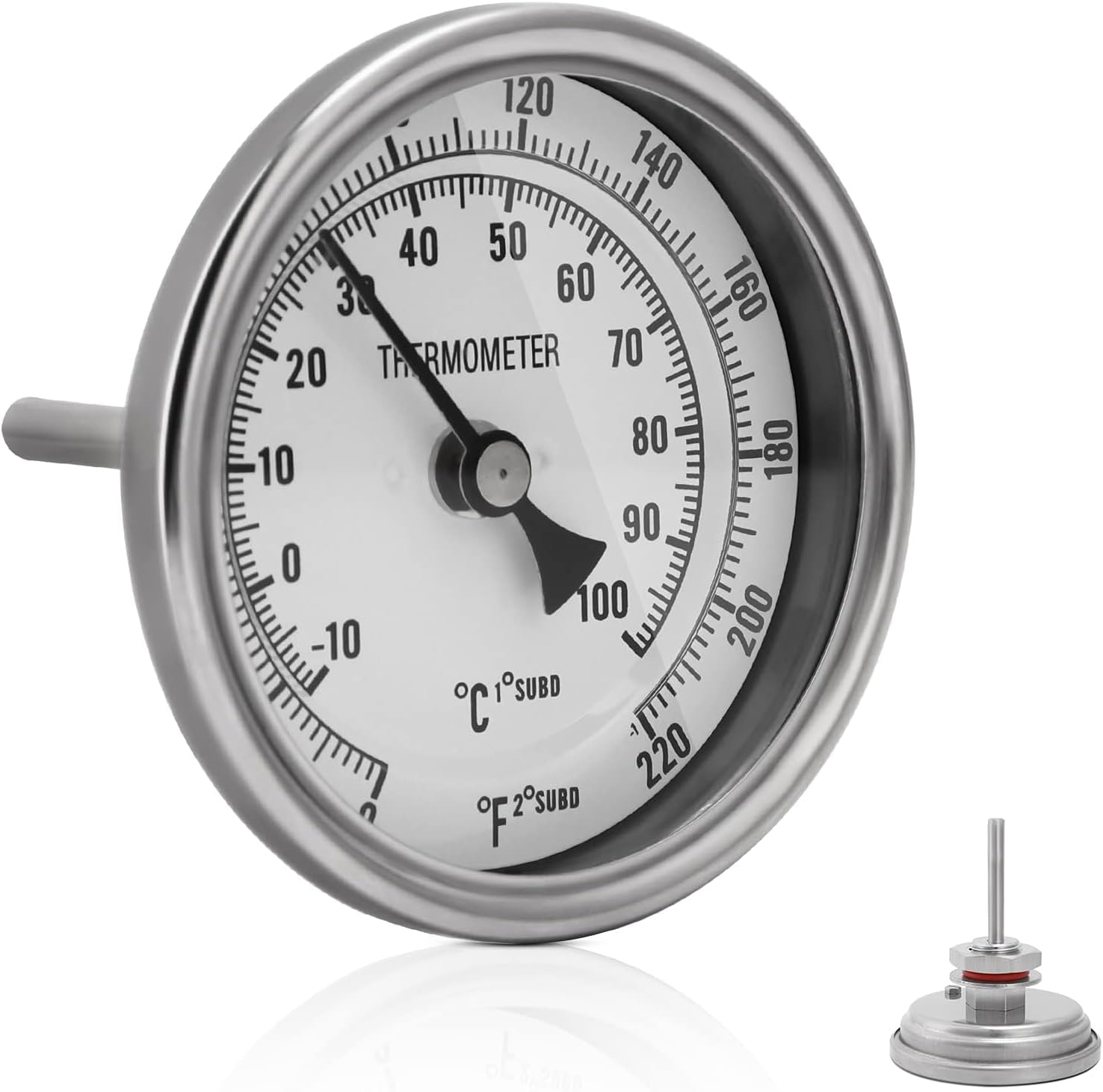 Visit on Amazon →For kettle temps, I want a dial thermometer I can read at a glance without bending over the steam. The FERRODAY 3" dial with a 2" stainless probe costs $15.99 and threads into a standard 1/2 NPT port, which most brew kettles have welded in. I've had mine on my 10-gallon brew kettle for two years and 22 batches, and it still reads within 2°F of my calibrated probe at mash temps.
The 2" probe is the right length for a 10-gallon kettle. It sits deep enough to read the wort's actual temperature without touching the bottom, where you'll get a false high reading from the burner. The dial face is large enough to read from three feet away, and the bezel doesn't fog up even during a vigorous boil.
What impresses me most is the response time. The dial settles within 20 seconds of a temperature change, which is fast enough to catch a mash drifting toward the low 140s before it ruins your beta-amylase rest. Buyer reports mention the same thing: one reviewer noted it matched their digital probe within 1°F across a 90-minute mash.
Flaws but not dealbreakers: The dial lags about 20 seconds on rapid temperature swings, so if you're adjusting flame and watching the thermometer, wait a beat before you make another adjustment. And the 2" probe won't reach deep enough for a 15-gallon kettle, so measure your kettle depth before you buy. For a standard 5 to 10 gallon setup, this is the one.
If you've ever lifted the lid to check mash temp and lost 5°F in the process, this thermometer ends that dance.
Upgrade Pick: aichose Brix Refractometer
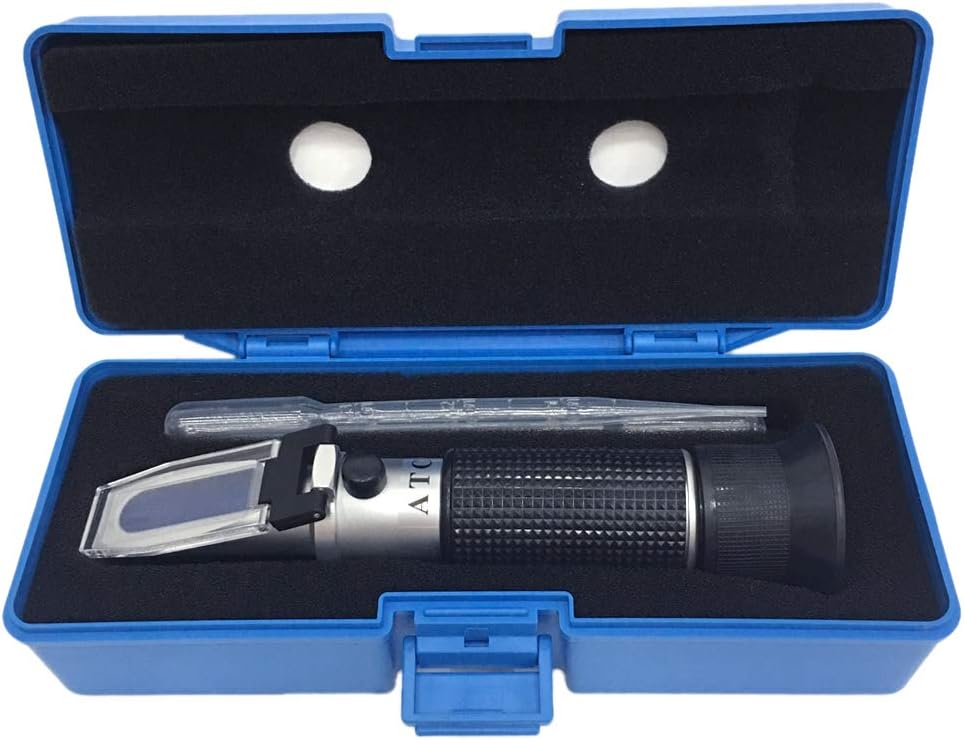 Visit on Amazon →A refractometer is the fastest way to check gravity, and the aichose model with automatic temperature compensation costs $18.99. I use mine for pre-boil gravity readings, where speed matters because I need to know if I should boil longer or add DME before the hop schedule starts.
A hydrometer takes a sample that has to cool to 60°F; a refractometer takes two drops and gives you a reading in five seconds.
The aichose reads in both Brix and specific gravity, which is convenient but not the point. The point is that it matches my hydrometer within 0.001 specific gravity on pre-fermentation samples, batch after batch. I've checked it against 30+ samples over the last year, and it's never been off by more than that. The ATC works, so I don't have to wait for the sample to cool to 60°F.
There's a catch, and it's a real one: after fermentation, alcohol in the sample skews the refractive index, so a refractometer reads artificially high. You need a correction factor or a calculator to convert the reading to true gravity. I use a free online calculator that asks for OG and the Brix reading, and it gets me within 0.002 of my hydrometer every time.
Flaws but not dealbreakers: The correction factor for post-fermentation readings is annoying, and the eyepiece is small enough that I have to squint. But for pre-boil gravity, which is where I need speed most, this thing is worth its weight in gold. One buyer review called it "essential for any serious homebrewer," and I agree.
If you've ever waited 20 minutes for a wort sample to cool to 60°F so you could decide whether to add DME, this refractometer saves you 19 of those minutes.
Budget Pick: CRBrewBeer Homebrew Kettle Clip On Thermometer
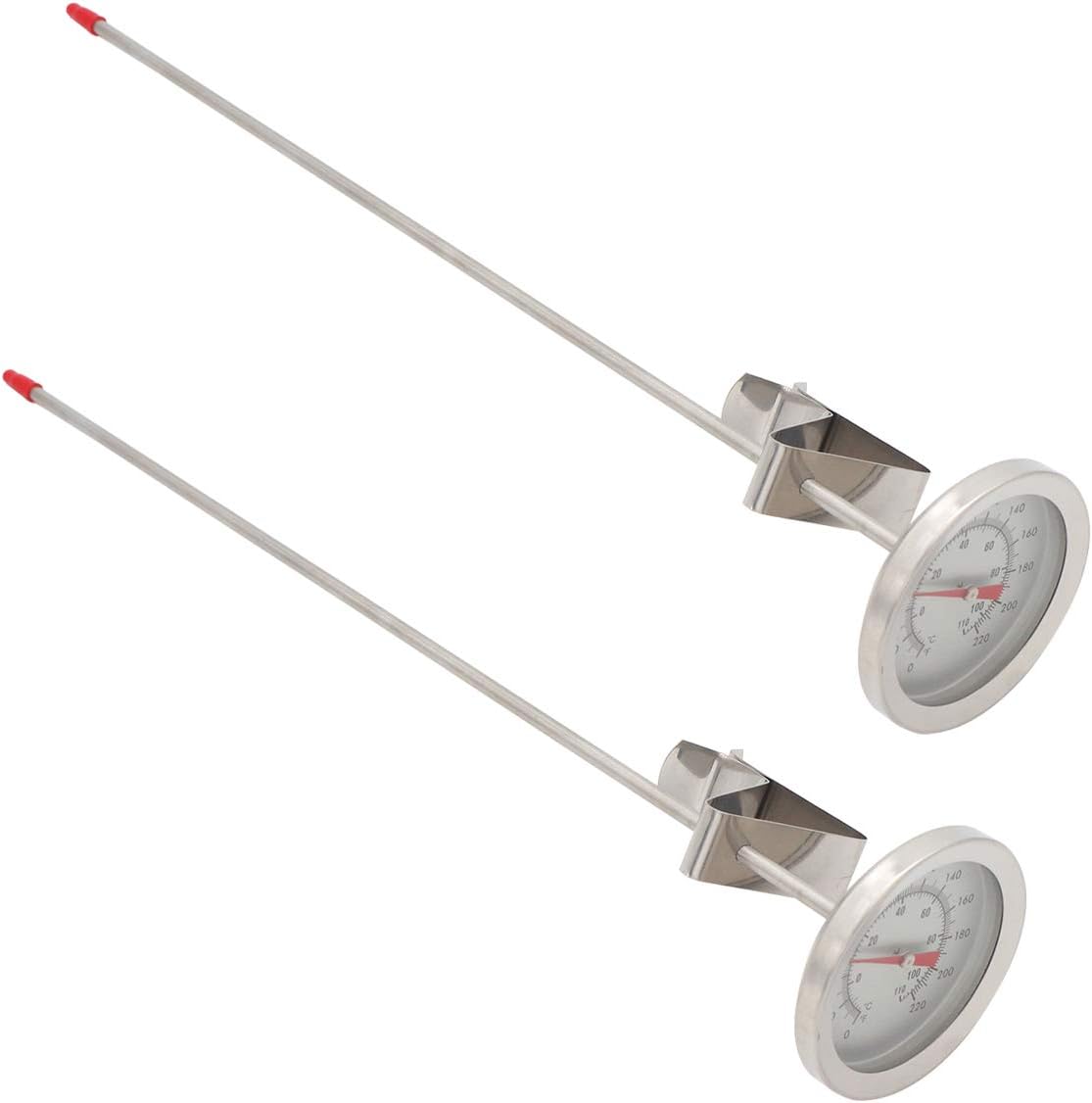 Visit on Amazon →Sometimes you don't have a welded port, and that's where the clip-on kettle thermometer comes in. This one has a 12" stainless probe and costs $17.99. The long probe is the whole point: it reaches deep into the kettle without needing a welded fitting, so it works on stockpots and cheap kettles that don't have ports.
The clip is a spring-loaded stainless clamp that grips the kettle rim. It held firm through a 90-minute boil with a vigorous rolling boil, and it didn't slip when I stirred with a paddle. The dial reads from 50°F to 550°F, which covers everything from strike water to a rolling boil, and it reads within 2°F of my calibrated probe at both 150°F and 212°F.
The long probe does have a downside: it extends about 8 inches into the kettle, which means it can interfere with a paddle if you're stirring aggressively. And the clip is designed for kettles up to about 3mm thick, so it won't grip a heavy-duty stainless kettle with a thick rim.
Flaws but not dealbreakers: The probe is long enough that it can dip into the grain bed during a mash, giving you a reading that's a few degrees off from the liquid wort. Clip it above the grain bed and you're fine. One buyer noted the same behavior and solved it the same way.
If you're brewing on a stockpot or a kettle without welded ports, this is the thermometer that gets you accurate readings without drilling holes.
The Competition
The Home Brewing Glass Thermometer costs $6.25 and it's the one I started with. It's accurate when it works, but it's fragile, slow to respond, and easy to break. I broke two before I gave up. The float needs to be fully submerged to read correctly, which means you're holding it in the wort and waiting for the mercury to climb.
That's fine for a quick check, but it's not a tool you can leave in the kettle during a mash. At $6.25, it's cheap, but I've spent more on broken glass than I would have on a dial thermometer.
The Triple Scale Hydrometer Kit at $13.99 is a solid backup for gravity readings, and it comes with a test jar, which most kits skip. But a hydrometer is a different tool than a thermometer. It's essential for OG and FG readings, and I use mine every batch, but it can't tell you anything about mash temperature.
If you need both, buy the hydrometer kit and pair it with one of the thermometers above.
The FERRODAY Dial and the Homebrew Kettle Clip are close in price, but they serve different setups. The FERRODAY is for kettles with a welded port; the clip-on is for kettles without one. If you have a port, the FERRODAY is the better choice because the dial is larger and the probe doesn't interfere with stirring.
If you don't have a port, the clip-on is the only option that doesn't require drilling.
The Bottom Line
Consistent batches start with consistent measurements. The Craft A Brew Fermometer at $8.99 is the best value on this list because it fixes the most common fermentation mistake for less than the cost of a six-pack.
The FERRODAY Dial at $15.99 is the best kettle thermometer for anyone with a welded port, and the aichose Refractometer at $18.99 is the fastest way to check pre-boil gravity.
The clip-on thermometer at $17.99 is the right call for stockpot brewers, and the glass thermometer at $6.25 is the one I'd skip, even at that price.
Over 20 batches, a $16 thermometer costs 80 cents per batch. That's the cheapest insurance you'll ever buy for your brew day.